Ottawa
The overall score of 80 reflects Ottawa's status as a safe, stable, and high-opportunity capital city. While it excels in safety, education, and job stability, the score is tempered by the rising cost of housing and the challenges associated with a sprawling transit-dependent layout.
Is Ottawa right for you?
MoveWiser can compare your budget, lifestyle, climate preferences, and priorities with Ottawa and other cities — and show you how well each one fits you personally.
See How Well Ottawa Fits MeQuality of Life in Ottawa
Ottawa's score is bolstered by its status as a major employment hub, particularly in the tech corridor of Kanata and the federal government sector, which provides high job security and competitive salaries. The city's commitment to public services, including a highly-rated healthcare system and bilingual education, further elevates its appeal for families and professionals. Conversely, the score is constrained by the high cost of housing, which has seen significant appreciation, making entry-level homeownership difficult. Additionally, while the O-Train light rail system has improved connectivity, the city's geographic sprawl and reliance on bus transit in outer suburbs lower the overall transportation and walkability scores.
Housing
Ottawa's housing market is currently characterized by balanced but cautious conditions, with buyers taking more time to make decisions amid economic uncertainty. While the market has seen modest price growth, there is an oversupply of rental condominiums in the downtown core, and multi-family townhouses have emerged as a fast-growing segment for first-time buyers and retirees.
Neighborhoods
The city features diverse residential areas, ranging from the urban, transit-connected core of Downtown and Centretown to the family-oriented, tree-lined streets of The Glebe. Students often gravitate toward Sandy Hill for its proximity to the University of Ottawa, while Westboro and Hintonburg are recognized as trendy hotspots for those seeking local boutiques and cafes.
Economy & Jobs
As Canada's capital, Ottawa maintains a stable economy anchored by the federal government, which remains a primary employer. The region also hosts a significant presence in the technology and healthcare sectors, with notable local employers including the Bank of Canada, the Royal Canadian Mint, and the Queensway Carleton Hospital.
Commuting & Transportation
Daily mobility is supported by OC Transpo, which operates an integrated network of buses and light rail transit (LRT) lines that connect major hubs like Tunney’s Pasture and Blair Station. While the LRT provides efficient cross-city travel, many residents still rely on personal vehicles, particularly when commuting from suburban areas to the downtown core.
Lifestyle & Amenities
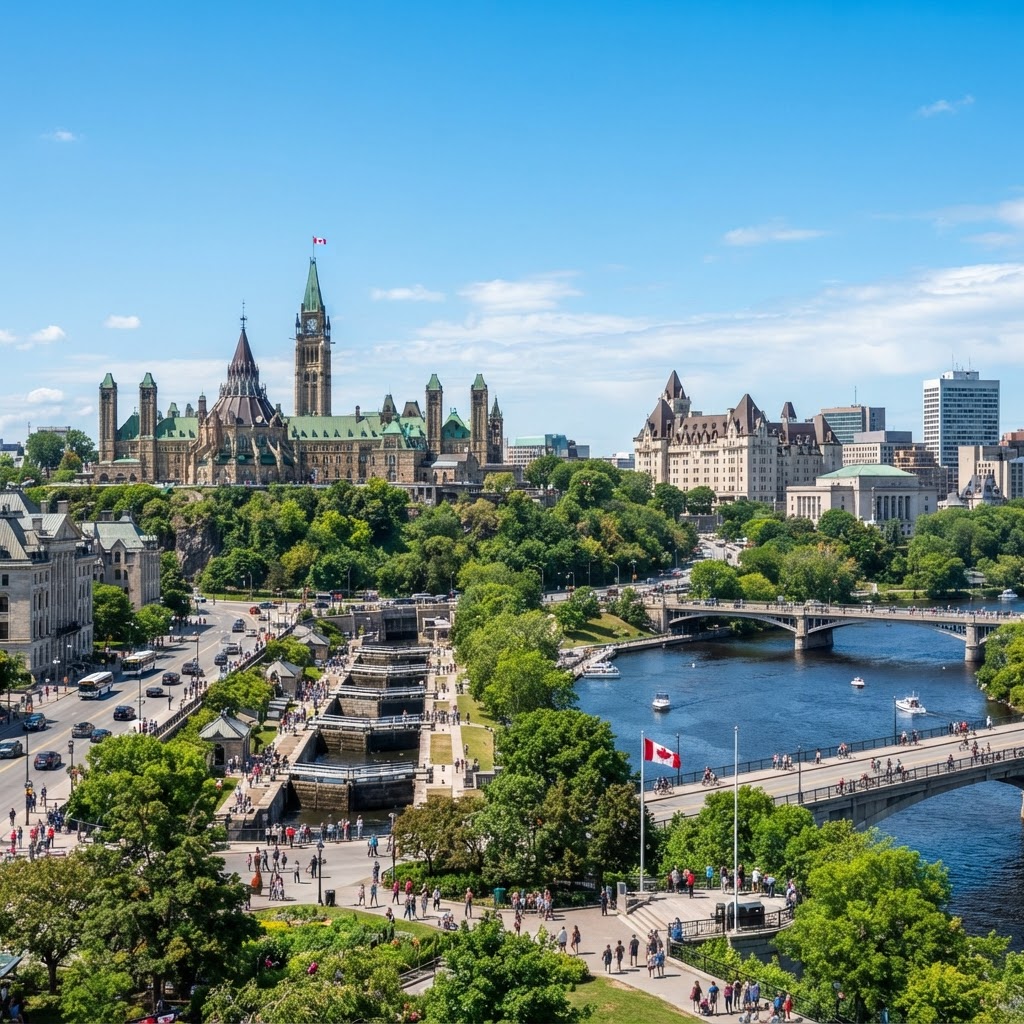
Ottawa offers a high quality of life that blends urban amenities with extensive outdoor access, including the Rideau Canal and nearby Gatineau Park for year-round recreation. Residents enjoy a rich cultural scene featuring national museums, festivals like Winterlude, and a diverse dining landscape centered around areas like the ByWard Market.
Climate
Ottawa experiences a humid continental climate with four distinct seasons, featuring warm, humid summers and cold, snowy winters. Temperatures frequently drop well below freezing in January, while July often sees highs near 26°C.
Cost of Living in Ottawa
Population
1,017,449
Median Home Price
$632,200
Median Rent
$1,949/mo
Average Salary
$64,500
Groceries / month
$520/mo








Moving to Ottawa
Ottawa is a clean, safe capital city with an excellent bilingual school system and a high quality of life. The culture is defined by the historic ByWard Market, national museums, and major festivals like Winterlude and Bluesfest. It is a nature-lover's paradise with the Rideau Canal and Gatineau Park nearby, and it provides a reliable light-rail and bus transit system for daily commuting.
Pros and Cons of Living in Ottawa
Pros
- • Strong tech and government job sectors
- • High quality of life and safety
- • Abundant green space and parks
- • Excellent bilingual education system
- • Rich cultural and festival scene
Cons
- • High cost of living and housing
- • Harsh, long winter season
- • Public transit reliability issues
- • Sprawling suburban layout
Who Ottawa Is Best For
Where Ottawa performs well
Frequently Asked Questions
Is Ottawa a good place to live?
Ottawa is widely considered an excellent place to live, particularly for families and professionals seeking a balance between urban amenities and nature. It offers a high standard of living, low crime rates, and a stable economy anchored by the federal government and a thriving tech sector in Kanata North.
Is Ottawa affordable?
Ottawa is moderately expensive, with housing costs being the primary driver of the cost of living. While it is generally more affordable than Toronto or Vancouver, the median rent for a one-bedroom apartment is approximately $1,949, and home prices remain high for first-time buyers.
What is Ottawa best known for as a place to live?
Ottawa is best known as Canada's capital, famous for the historic ByWard Market, the Rideau Canal—a UNESCO World Heritage site—and its vibrant festival culture like Winterlude. It is also recognized for its high concentration of tech companies and its status as a bilingual, family-friendly city.
What are the biggest advantages of living in Ottawa?
The primary advantages include a robust job market in government and technology, access to world-class healthcare facilities, and a high-quality public school system. Residents also enjoy extensive recreational opportunities, such as cycling along the canal or visiting Gatineau Park.
What are the potential disadvantages of living in Ottawa?
The most significant drawbacks are the long, cold winters and the city's sprawling geography, which can make car ownership necessary in many neighborhoods. Additionally, the public transit system, including the O-Train light rail, has faced reliability challenges that can complicate daily commuting.
What type of person or household is Ottawa a good fit for?
Ottawa is an ideal fit for families looking for safe neighborhoods and top-tier schools, as well as young professionals working in the tech or public sectors. It is also well-suited for students attending institutions like the University of Ottawa or Carleton University who value a stable, culturally rich environment.
Related rankings
Cities Similar to Ottawa
Data & sources
MoveWiser scores are AI-generated comparative estimates, not official statistics. The category scores above are produced by MoveWiser's data pipeline; cost figures and population are AI estimates informed by web data at the time of generation. Always verify specifics with primary sources before deciding.
Data sources (as reported during generation):
- Invest Ottawa 2025
- WOWA.ca Housing Market Report 2026
- Rentals.ca Network Data 2026
- Job Bank Canada 2025
- Numbeo 2026 — cost of living, rent & groceries
Find cities that fit you — not just one
Get personalized city recommendations with match percentages based on your exact budget, lifestyle, climate, and priorities — Ottawa included.
Get My Personalized MatchesCookies & ads
We use cookies and similar technologies to personalize ads, measure ad performance, and improve your experience. Third-party vendors (including Google) may use cookies to serve ads based on your prior visits. See our Privacy Policy for details.